
Start a Bibb County Property Records Search
Your starting point depends on the fact already in hand. When an address is what you have, the Bibb qPublic search is the practical address-to-parcel route. It can show the owner carried on the tax roll. It also gives separate location and mailing addresses, legal text, values, sale clues, and deed or plat references. For filed land instruments, the Clerk's eSearch is the place to look. Macon Insights and the public CAMA layer add spatial context.
Never lean on one result alone. A tax-card owner can lag behind a new deed. A deed may describe only part of a larger modern parcel. And a GIS line is not a survey. Carry the parcel number, legal description, party names, and book/page together. Move them between sources as you go.
- Search qPublic by location address. Copy the parcel number, owner field, legal description, and recording references.
- Carry the current owner or book/page into eSearch. Compare the deed's parties and land description.
- Open the Tax Commissioner route for the bill, payment, exemption, delinquency, or FiFa question.
- Match the parcel geometry and attributes in Macon-Bibb GIS, keeping its reference-only limits in mind.
- Use the office counter, mail, phone, JustFOIA, archives, or library when a portal stops short.
Match Bibb County Property Records to the Right Office
Three offices hold the core trail in Bibb County. The Superior Court Clerk keeps deeds, liens, plats, and related land filings. The Board of Tax Assessors appraises property and maintains the parcel card and tax map. The Tax Commissioner bills and collects the tax but sets no value. Call the right desk. That keeps a tax question from being mistaken for a deed or valuation question.
Bibb County Clerk of Superior Court
601 Mulberry Street, Suite 216
Macon, GA 31201
478-621-6527
Macon-Bibb Board of Tax Assessors
688 Walnut Street, Suite 200
Macon, GA 31201
478-200-5550
Macon-Bibb Tax Commissioner
188 Third Street
Macon, GA 31201
478-621-6500
Read Bibb County Property Records in qPublic
A Bibb sample card shows how much the assessor result covers. It separates Owner, Owner Mailing, and Location Address. It then adds the parcel number and legal description. It also lists class, zoning, tax district, millage, acres, neighborhood, homestead status, map control, sales, and value history. Improvement, permit, photo, sketch, and land modules appear whenever the parcel holds that kind of data.
| Search field | Input type | Practical note |
|---|---|---|
| Owner Name | Text with exact-match option | Test partial and entity-name variants when exact search is too narrow. |
| Location Address | Text with exact-match option | A street range such as 1200-1299 Main is supported by the interface pattern. |
| Parcel Number | Local parcel key | P074-0396 is a public example, not a published formula for all parcels. |
| Legal Information | Subdivision or legal text | Useful when a present street label does not match the older record. |
The sample carries a last-certified-roll disclaimer. Check its sale and owner fields against the newest recorded deed before drawing any current-title conclusion.
Open Bibb County Land Records Back to 1950
The local Bibb eSearch portal advertises real-estate index coverage from January 3, 1950. Georgia Land Records begin January 1, 1998, and the standard and pre-standard lien and plat families each have their own published runs. Guest access shows index information only. Viewing, printing, or downloading land-record images requires an account.
The portal lists a $0.50 per-page print or download charge, no subscription fee, and a $2 minimum credit-card purchase that prepaid-account handling can avoid. The cost distinction matters. You can gather an index citation without assuming the image itself is free.
Open Bibb eSearch to reach the land-record entry.
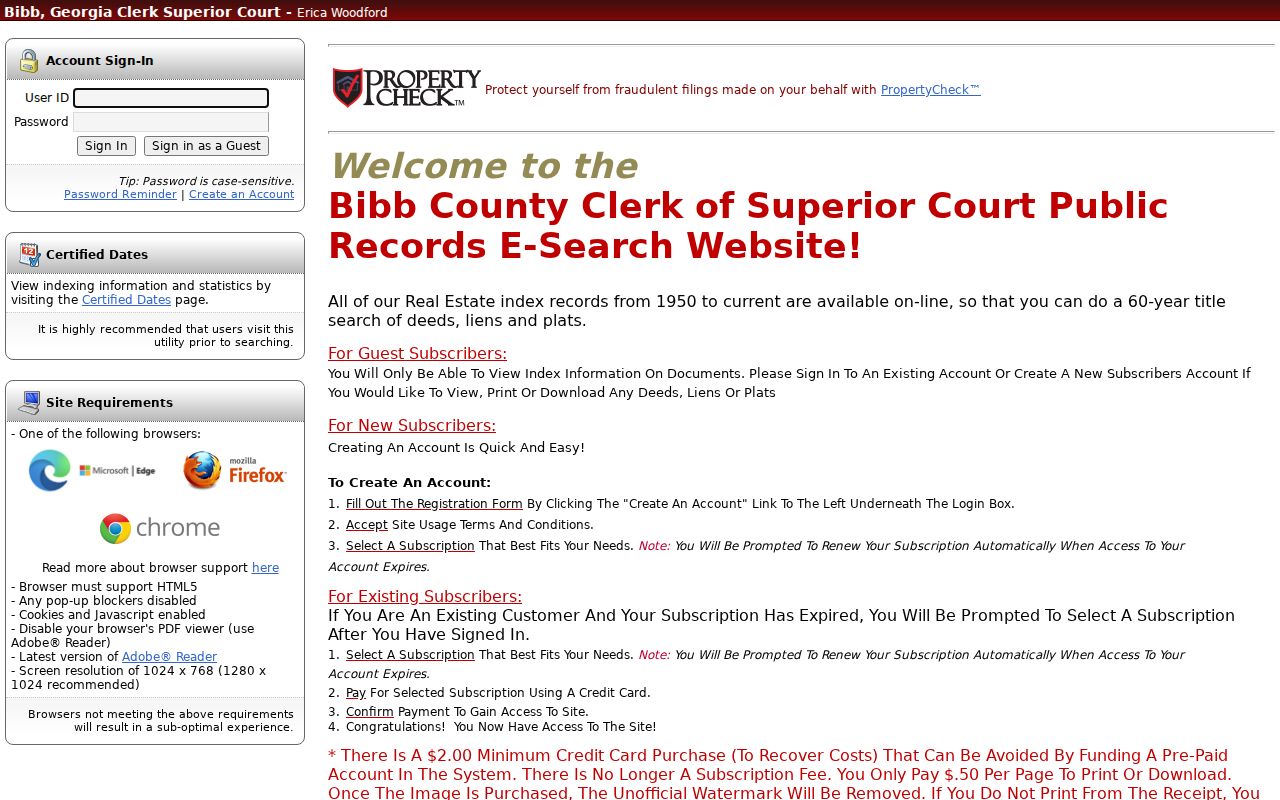
The screen shows the official portal environment. A real result row and the full document-type menu appear once a query is run.
Compare Bibb County and Statewide Deed Index Depth
Bibb's local index reaches farther back than the advertised statewide baseline. The GSCCCA real-estate search describes statewide transactions. It covers them from January 1, 1999, with 1993-1998 being added. Its name, property, instrument, and book/page routes can help. But it does not replace the deeper local starting point.
| Route | Published starting point | Best role |
|---|---|---|
| Bibb eSearch | January 3, 1950 | Local chain, liens, plats, and images |
| GSCCCA | January 1, 1999 statewide | Cross-county name, property, and instrument search |
| Books and archives | Earlier runs vary by collection | Pre-1950 deeds and historical context |
A cutoff marks an index or digitization boundary, not the birth of Bibb County land records. When the online chain ends, keep going with books and microfilm.
Crosswalk Bibb County Property Records Through CAMA GIS
The public Macon-Bibb CAMA layer exposes parcel geometry beside parcel number, map route, site address, and owner and mailing attributes. It also carries acres, tax district, homestead flag, deed page, plat page, sale data, values, neighborhood, and subdivision fields.
The service supports JSON, GeoJSON, and PBF queries, with a 2,000-record request limit. The layer lists a January 14, 2026 edit date. Treat that as a service timestamp. It is not proof that every owner, deed, or assessment field was refreshed after its source changed.
Inspect the official CAMA service for its full attribute list.
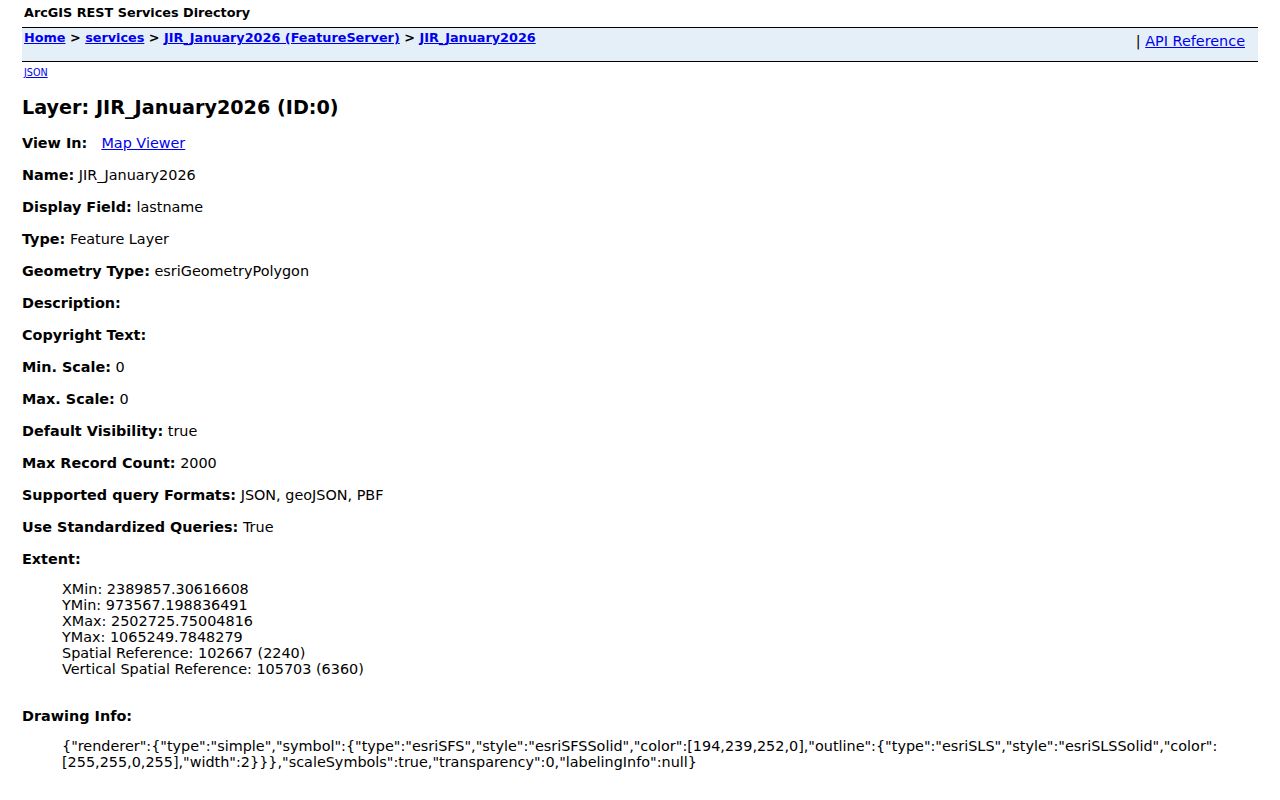
The attribute schema works well as a cross-system bridge. Its geometry remains reference data, though, and cannot replace a boundary survey or a recorded plat.
Separate Bibb County Property Records Values From Tax Bills
The Assessor sets the value, and the Tax Commissioner sends the bill. Georgia's formula starts with fair market value at 100 percent, as the Commissioner lays it out. It then applies a 40 percent assessment ratio. Tax is calculated on assessed value once exemptions and millage are figured in. None of that equals a sale appraisal. So treat the numbers as tax math rather than a market opinion.
The Tax Commissioner site is the hub for real, personal, mobile-home, and timber tax. It also covers payments, installments, exemptions, delinquency, FiFa, and tax sales. You can also reach the office by phone at 1-844-828-3222 or 478-621-6500, by mail at P.O. Box 4724, or at the Third Street counter.
The May 2025 assessment notices drew on the January 1, 2025 owner of record. They used 2024 sales for market adjustments. The notices opened a 45-day appeal window. They cautioned that estimated tax amounts could still shift.
Know Which Bibb County Property Record Answers the Question
Property evidence is layered. A deed records a conveyance. An assessment card describes the taxable parcel. A plat maps a recorded subdivision or tract. When the normal ownership trail changes course, court, probate, permit, and tax-sale files add the missing context.
| Record Type | What It Documents | Kept By | Access |
|---|---|---|---|
| Deeds | Parties, conveyance, legal description, and filing reference | Superior Court Clerk | Guest index; account for images |
| Mortgages and liens | Recorded claims, security interests, releases, and satisfactions | Superior Court Clerk | eSearch index and Clerk |
| Assessment and tax | Owner on roll, values, exemptions, bill, payment, and delinquency | Assessor and Tax Commissioner | qPublic, tax portal, phone, mail, counter |
| Plats and parcels | Lot, subdivision, map attributes, deed page, and plat page | Clerk and Macon-Bibb GIS | eSearch, CAMA layer, Mapping |
| Permits and code | Applications, inspections, status, reports, and compliance context | Building and Fire; Code Enforcement | Community Connect, reports, request |
| Court and probate | Quiet title, partition, enforcement, estate authority, and heir context | Courts and Probate Court | Linked portals and clerk files |
Define your Bibb County terms before comparing records, since one word can shift meaning.
- Grantor and grantee
- The parties conveying and receiving an interest in a deed.
- Parcel or APN
- The assessor's identifier for a mapped tax parcel.
- Assessed value
- The value used in Georgia's tax calculation after applying the assessment level.
- Plat
- A recorded map that can show lots, streets, and survey information for a tract or subdivision.
Choose the right Bibb County property record for the question. Use the Bibb County deed records route for the filed transfer itself, since a parcel card's sale panel is a clue rather than a substitute for that instrument.
Add Bibb County Permit and Code History by Address
A property's story extends past deeds and tax bills. Bibb County routes building and fire permits through Community Connect. An account there unlocks applications, uploads, payments, inspection scheduling, status updates, and permit downloads. The scheduler searches by address or permit number, and 478-803-0466 works as a phone fallback.
Monthly permit reports open a second window into county activity. Code Enforcement adds a dashboard. It covers nuisance cases, unsafe buildings, demolitions, compliance actions, and service requests. Anything not published can still be requested. Cite the address, permit number, date, and document type when asking.
One timing detail deserves attention. County materials describe a construction-code transition effective January 1, 2026. Applications filed before February 1, 2026 may qualify under the prior codes. The filing date on a permit record can therefore change what that record means.
Follow Bibb County Property Records Through Probate and Court
Ownership chains rarely stay tidy. An estate, a quiet-title suit, a partition, a foreclosure, lien enforcement, or a sheriff sale can each break a clean owner-to-owner trail in Bibb County property records. Bibb Probate points researchers to a general index covering 1823-2004, inferior-court material from 1827-1863, historical probate records from 1829-1989, and 2005-present cases through Georgia Probate Records. Historical probate images are described as free to search, with printing at $1 per page.
For litigation beyond probate, reSearchGA serves as the county's civil and criminal portal route, while PeachCourt functions as an e-filing and document platform rather than a guaranteed free docket. When an index hides the filings, go to the clerk for the actual case or estate file. Pull the case number, estate name, party roles, recording reference, and legal description together, because a probate inventory or docket establishes who had authority while the later recorded deed proves the conveyance itself.
Tax and foreclosure trails demand the same patience. A FiFa is the Tax Commissioner's execution record for unpaid tax, and the General Execution Docket plus related Clerk filings may hold the recorded claim. Tax-sale notices and deeds show the later steps, but read them beside the parcel, the notices, and any court action. For an ordinary lien, locate the original filing and its release, satisfaction, cancellation, or discharge before calling the claim current. Remember too that the standard, pre-standard, hospital-lien, and land-record series carry different index spans, so the document's date and family belong in every careful deed records search.
Go Beyond the Web for Early Bibb County Property Records
Some early Bibb County property records survive in rough shape. The Georgia Virtual Vault record for Bibb Deed Book D documents an 1834-1837 microfilm volume. It holds deeds, mortgages, sheriff sales, and other transactions. It is unindexed and damaged. The finding record notes stains, tears, blur, irregular pagination, and missing pages.
No source backs a courthouse-fire story for a missing Bibb decade. Before assuming broad loss, search nearby volumes, re-recordings, probate, sheriff or foreclosure deeds, and plats. A broken chain may just be a broken index. The FamilySearch Georgia wills and deeds collection extends that fallback chain. Georgia Archives and local library archives extend it too.
The contrast is stark: a modern local index begins in 1950, while a surviving early deed book reaches into the 1830s. Work the middle through books, not assumptions.
Layer Macon Directories and Sanborn Maps Over Bibb Deeds
Macon directories and Sanborn maps add another lens. The Digital Library of Georgia carries Macon directory items from 1884, 1892, 1900, and 1909 within a catalog range described as 1850-1950. The 1900 directory shows person, address, occupation, and employer conventions. The 1908 Sanborn map adds footprints and use context.
A directory occupant is not necessarily the property owner. Occupancy is not title. Use each layer for its own job. The directory places a person, the Sanborn sheet studies the structure and block, the tax card identifies the modern parcel, the plat fixes subdivision geometry, and the deed chain documents conveyance. That layered method reconstructs a house trail without turning an occupancy clue into title evidence.
Note: The 1892 directory places the courthouse at Mulberry and Second, a useful reference when normalizing an old Macon address.
Request Missing Bibb County Property Records
A failed portal is rarely a dead end. Bibb County keeps its records across several desks. The Clerk counter, the Assessor, the Tax Commissioner, the Mapping Department, court clerks, archives, and the library each hold a piece of the trail. For an online route, the Macon-Bibb JustFOIA portal accepts open records requests, though a written request sent straight to the custodian works too.
The Georgia Open Records Act sits at O.C.G.A. sections 50-18-70 through 50-18-77. The Attorney General advises an agency to acknowledge a request within three business days, or to explain its timing, cost, redactions, or an exemption. Be specific in what you ask for. Name the address, parcel number, deed book and page, permit, case number, date range, or document type. A narrow request beats a broad sweep through everything about one person.
Mapping sells a range of products. Its published list covers partial property maps, transfer cards, large maps, PDF files, CAD or GIS data, complete property maps, ownership books, and a street-index book. Ask for the named product and confirm its coverage before ordering.
Phones, mail, and the counter still matter. An account gate, captcha, large-file limit, or damaged scan can block the web route at any time. Keep notes: the office name, the request date, the quoted fee, and any exemption cited. If an agency redacts a protected field, ask whether the rest can be split out and released. Never send a Social Security number, bank detail, or full identity document to an unverified mailer. Pull county and state contact information from their published domains, especially when a deed-copy solicitation, court text, or zoning invoice demands payment.
Set Limits on Bibb County Property Records
Bibb County property records answer many questions but not all of them. The assessment roll shows the owner of record, filed conveyances, tax status, parcel geometry, permits, and plats. It also lists recorded encumbrances. That is a lot. Yet no roll can guarantee clear title, fix a legal boundary, or prove present condition. It cannot set what a willing buyer would pay. Dates deserve caution too. A certified-roll date and a GIS edit date do not prove every field changed together.
Use records lawfully. Bibb County property records support due diligence, boundary research, appeals, estate work, and civic review. Never use owner data to stalk, harass, threaten, dox, or trespass.
Georgia's stalking provisions appear at O.C.G.A. sections 16-5-90 and 16-5-91. Public access to property records never excuses harmful conduct. Sensitive identifiers can be redacted on request, and a protected or substitute address should never be reverse-engineered through another record.